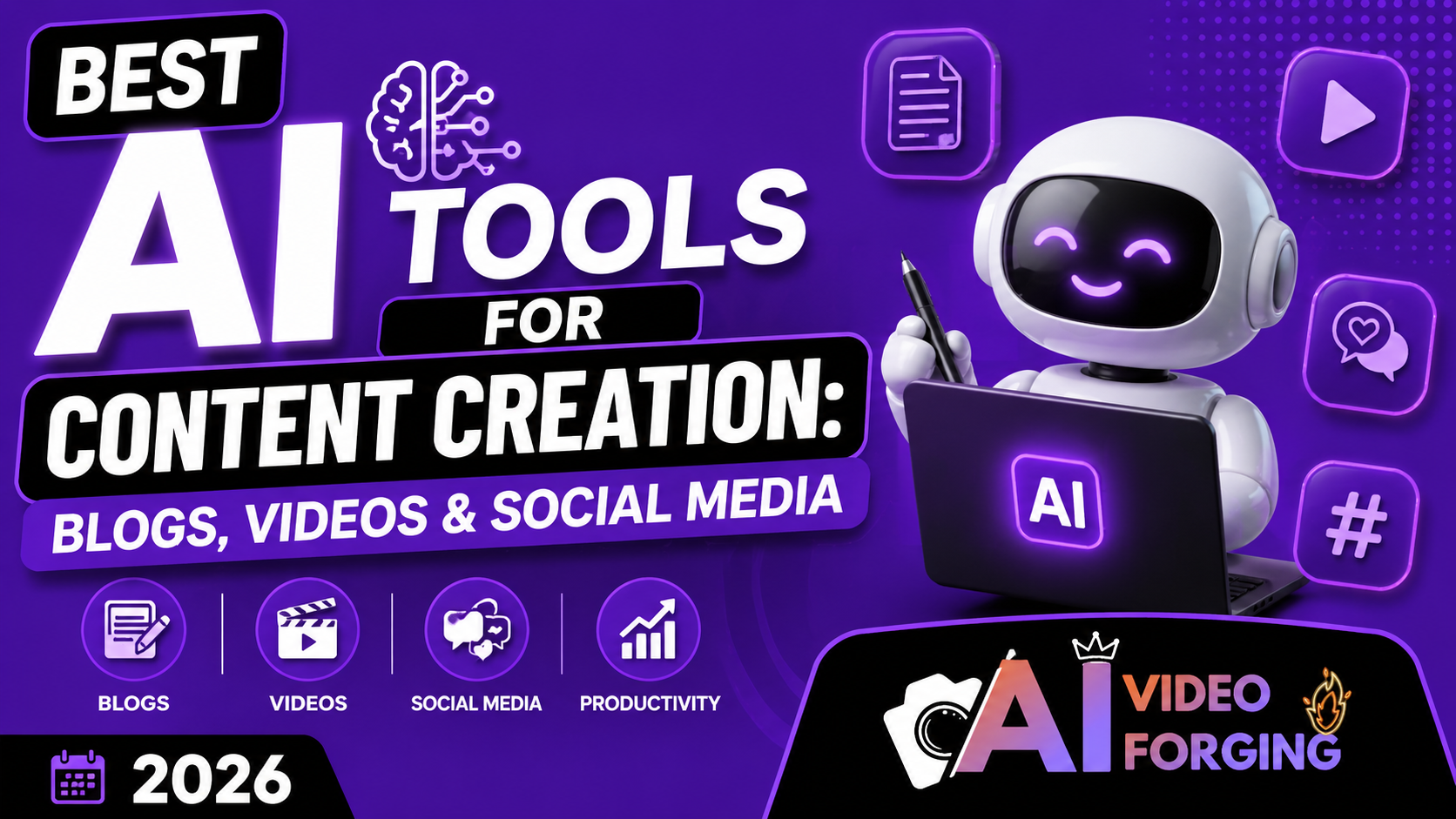
Best AI Tools for Content Creation: Blogs, Videos & Social Media 2026
 AI Video Forging
Best AI Tools for Content Creation: Blogs, Videos & Social Media 2026
Overview of AI Tools Transforming Blog Content Creation in 2026
In 2026, AI platforms for blog content creation have advanced significantly, delivering automation and quality enhancements that are reshaping writing and publishing workflows for developers and content creators.
Leading AI writing assistants like Copy.ai and Grammarly now provide more than just grammar and spelling checks. Copy.ai leverages large language models to automate ideation and drafting, allowing writers to rapidly generate content outlines, introductions, and even full paragraphs tailored to specific audiences. Grammarly enhances writing quality with context-aware suggestions that go beyond style and tone, incorporating clarity, engagement, and delivery improvements. These tools reduce the manual labor of initial drafts and revisions, accelerating content production cycles (Postiv AI Blog[1]).
To further optimize blogs for search engines and relevance, integrations with platforms such as Surfer SEO and Perplexity have become standard. Surfer SEO analyzes competitor content, keyword density, and search trends in real-time, enabling precise keyword optimization directly within the writing interface. Perplexity introduces context-aware research capabilities, returning summarized, relevant information and citations that inform content accuracy as the text is composed. This fusion of writing and research streamlines content strategy and quality assurance in one environment (Meet Sona[2]).
Emerging platforms like Postiv AI support end-to-end workflow automation by incorporating brand and tone personalization features. Developers can customize writing assistants to reflect specific brand voices, styles, and messaging guidelines, ensuring consistency across all blog posts without manual oversight. These platforms also automate scheduling and publishing tasks, integrating seamlessly with CMS and social media distribution tools, thus reducing time spent on administrative overhead (Postiv AI Blog[1]).
Collectively, these AI tools significantly reduce the time required for traditional stages of blog content creation, including ideation, drafting, editing, and SEO optimization. Early phase research and outline creation are accelerated by AI-generated suggestions, while ongoing editing benefits from real-time feedback on tone, clarity, and SEO compliance. This shift not only speeds up individual post creation but also enables scaling content production across multiple topics and formats efficiently.
Scalability is another critical performance aspect addressed by these platforms. Cloud-based AI writing assistants handle high-volume content generation without degradation in speed or quality. This scalability supports organizations looking to produce large quantities of personalized blog content to engage diverse audience segments or maintain rapid publishing schedules, a growing requirement with the increasing competition in digital content space.
In summary, the ecosystem of AI tools in 2026 empowers developers and technical writers to produce higher-quality blog content faster and more consistently. By combining writing automation, integrated SEO and research functionalities, and automated workflow features with scalable performance, these platforms are transforming traditional content creation workflows into streamlined, data-driven processes that deliver measurable impact (Best AI Content Creation Tools in 2026: 12 Platforms Tested and Compared[1], Best AI Content Creation Tools In 2026 | Meet Sona[2]).
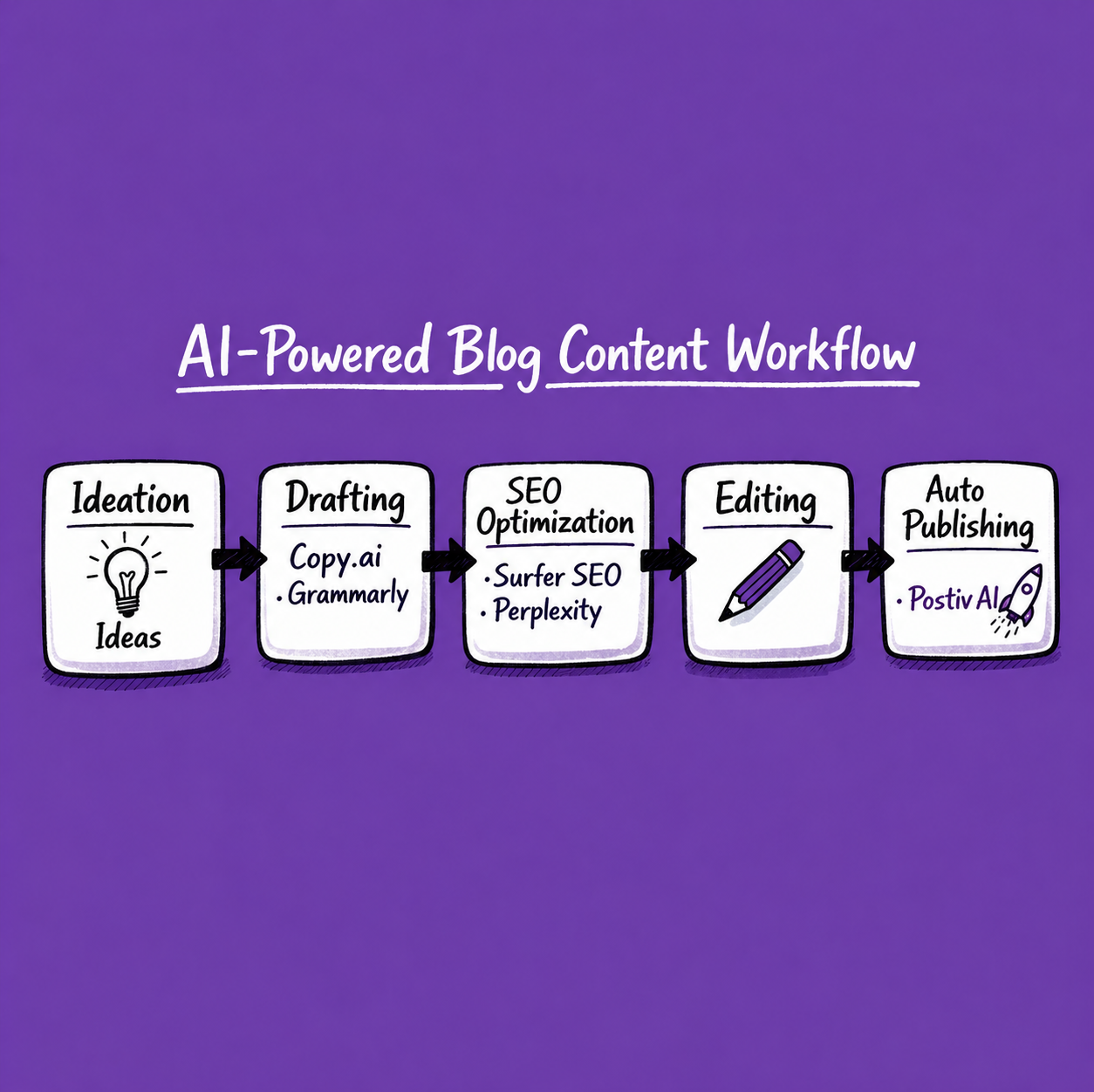 Whiteboard style diagram illustrating AI-powered blog content creation workflow including ideation, drafting, SEO optimization, editing, and publishing.
Hand-drawn style workflow diagram of AI-supported blog content creation stages with tools like Copy.ai, Grammarly, Surfer SEO, and Postiv AI.
Cutting-Edge AI Video Creation Tools Shaping 2026 Visual Content
The 2026 landscape of AI-driven video creation is defined by robust platforms that streamline the entire production pipeline, enabling developers to craft high-quality visual content with unprecedented efficiency. Among the top contenders, Google Veo 3, Synthesia, HeyGen, and Alibaba’s Qwen stand out for their unique strengths and integration capabilities.
Comparative Capabilities of Leading AI Video Generators
- Google Veo 3 excels in high-fidelity video synthesis with support for 4K resolution and fast rendering times. Its multimodal understanding allows seamless fusion of text inputs and image prompts to generate dynamic scenes with minimal manual intervention.
- Synthesia is a pioneer in AI avatar-based video creation, offering highly customizable digital presenters and comprehensive voice cloning services. Its multilingual support makes it ideal for global training and marketing content.
- HeyGen specializes in user-friendly templates and interactive video elements driven by AI, making it suitable for rapid social media video production with consistent branding.
- Alibaba’s Qwen integrates deep natural language understanding to generate context-aware video narratives, pairing well with e-commerce and educational applications that require precise storytelling.
Multimodal AI Content Generation for Efficient Workflows
These platforms increasingly leverage multimodal AI, combining text, image, and video modalities to create cohesive multimedia assets that reduce the need to switch between separate tools. Developers can input scripts, reference images, or previous video snippets, and the AI synthesizes these into polished videos, accelerating iteration cycles while maintaining creative control.
AI-Driven Video Editing Tools Integrating Sora 2 and Veo 3.1
Beyond generation, editing tools like CapCut have integrated advanced AI models such as Sora 2 and Veo 3.1 to automate complex edits in seconds. Features like intelligent scene detection, automated color correction, and style transfer allow for post-production workflows that previously required expert technicians now manageable via accessible APIs, empowering developers to embed editing capabilities into custom applications.
AI Avatars, Voice Cloning, and Multilingual Support
AI avatars combined with voice cloning have become essential in business and training videos to personalize communication at scale. Tools supporting multiple languages and dialects help companies cater to diverse audiences without costly reshoots or localization efforts. This capability notably reduces turnaround time for global campaigns and enhances learner engagement in education technology platforms.
Performance and Quality Considerations
When selecting AI video tools, developers must consider:
- Rendering speed: Google Veo 3 offers industry-leading GPU-accelerated rendering, reducing content delivery time dramatically.
- Resolution support: Platforms now routinely support HD up to 4K video, with newer models ensuring minimal artifacting in upscaled outputs.
- Output quality: Balancing photorealism with generation speed remains critical, and models like Qwen optimize this tradeoff through adaptive detail algorithms.
Overall, these tools expand creative possibilities and redefine video content pipelines, allowing developers to build scalable, AI-powered video workflows for a variety of applications in 2026 and beyond.
For detailed comparisons and benchmarks of these and other AI video tools, see resources such as Postiv AI Blog[1] and Higgsfield AI[3] (Source[1]) (Source[3]).
AI-Powered Social Media Content Creation and Management in 2026
The social media landscape in 2026 is deeply integrated with AI-driven tools that enhance content creation, scheduling, and analytics to help developers and marketers streamline their workflows and maximize engagement. Leading platforms like Buffer, Publer, and FeedHive now embed advanced AI capabilities for generating posts, images, and personalized content tailored to diverse audience segments. These integrations reduce manual workload by enabling quick ideation and automatic content adaptation across multiple social channels, fostering more dynamic and relevant social presences (Buffer[4], Pingenerator[5]).
AI-enabled scheduling tools have evolved significantly, offering conditional posting features that react to real-time engagement metrics and trending topics. Solutions such as Eclincher support complex scheduling rules where posts are automatically delayed, prioritized, or rotated based on topical relevance and audience behavior patterns. This brings a new level of automation, letting developers set triggers for thematic campaigns and track performance topic-wise, thereby optimizing reach and timing without constant manual oversight (Eclincher[6]).
On the analytics front, AI-driven platforms like Metricool and Eclincher deliver robust insights by analyzing brand mentions, sentiment, and competitor strategies in real time. These tools use natural language processing and pattern recognition to mine actionable data, enabling rapid response to audience feedback and emergent trends. Brand monitoring is now more precise, empowering teams to safeguard reputation proactively and tailor messaging strategies with data-backed confidence (Zapier[7]).
Another critical advancement supporting seamless workflows is the integration of content creation tools with publishing and automation services such as Zapier. Developers can connect AI-generated posts or image assets directly to scheduling platforms or social accounts, automating the entire process from ideation to publication. This reduces friction and manual handoffs, accelerating campaign deployment while ensuring content consistency across channels (Zapier[7]).
Moreover, AI plays a pivotal role in maintaining brand consistency through style enforcement and intelligent content recycling. Algorithms now analyze previously published posts to reformat and resurface high-performing content tailored to different formats or audience segments. This capability not only preserves a unified brand voice but also maximizes content ROI by extending shelf life and adapting messages dynamically without starting from scratch.
Together, these AI-powered social media tools form a powerful ecosystem that reshapes how developers and marketers plan, produce, and manage their digital presence. By leveraging AI for content generation, optimized scheduling, precise analytics, automation, and brand consistency, teams can enhance productivity while delivering more engaging and relevant social experiences in 2026.
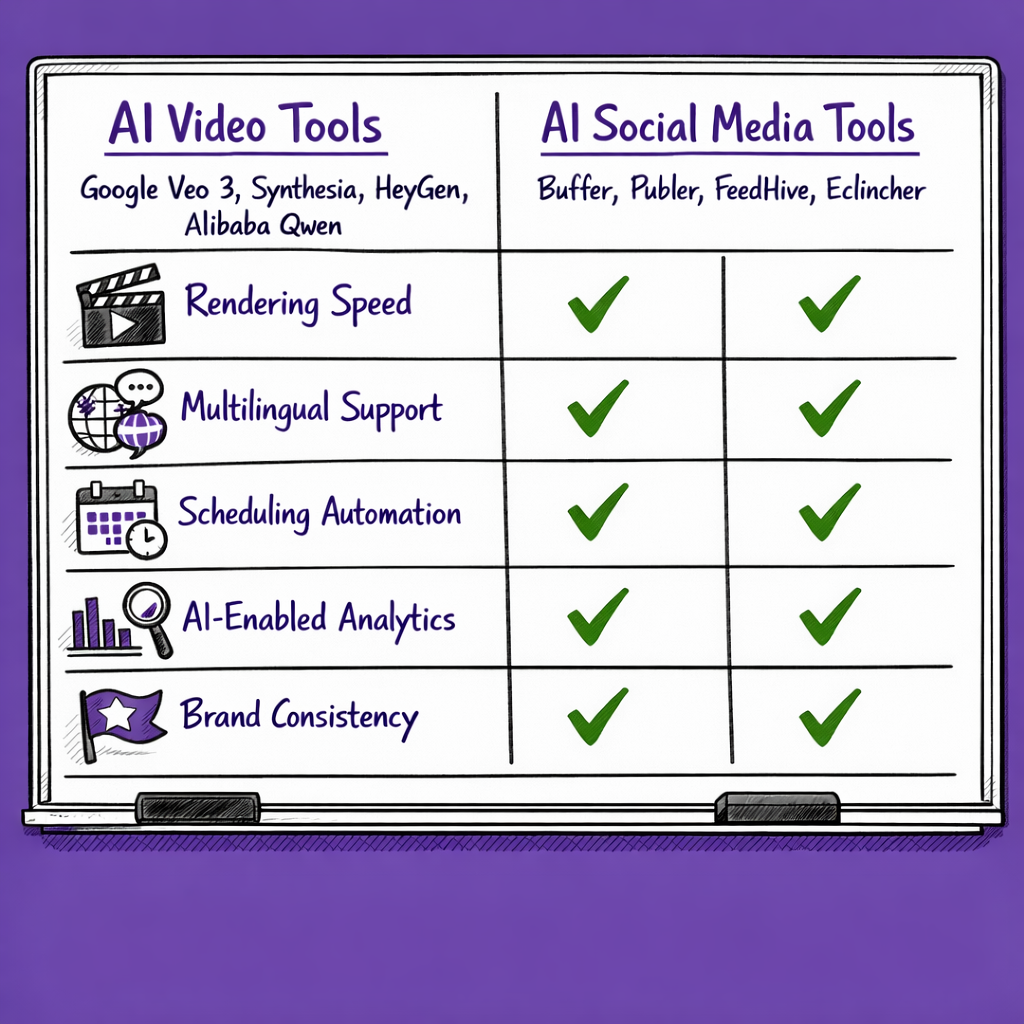 Hand-drawn comparison table of leading AI video and social media tools highlighting features like rendering speed, multilingual support, scheduling automation, and analytics.
Whiteboard style comparative table of AI video and social media content creation tools focusing on key features and performance metrics.
Integrating AI Tools Seamlessly into Developer Content Workflows
In 2026, developers aiming to harness AI for content creation benefit greatly from tools designed with robust API access and integration capabilities. Most leading AI content creation platforms provide RESTful APIs or SDKs that allow developers to embed content generation, video synthesis, and social media scheduling functions directly into existing pipelines. This API availability enables automation and customization, such as triggering text generation upon publishing milestones or automatically generating video summaries from blog posts.
Interoperability among AI tools across formats—blogs, videos, and social media—is becoming increasingly standardized. Many blogging platforms now support plugin architectures or webhooks that connect to AI writing assistants, while video generators often export in widely supported formats (MP4, GIF) compatible with social schedulers. Social media management APIs, on the other hand, accept diverse media types and accommodate scheduling metadata, smoothing the flow from content generation to distribution.
Maintaining content quality and brand voice consistency is critical when employing automated tools. Strategies include defining custom style guides or tone parameters within AI writing tools and using model fine-tuning or prompt engineering to align output with brand identity. Establishing review checkpoints where generated drafts are validated by human editors also helps safeguard quality. Similarly, video AI tools often allow template-based customization and brand asset integration to ensure videos adhere to corporate styling.
For debugging and observability in multi-step AI content pipelines, developers should instrument each stage with logging and quality metrics. For example, recording generation latency, token usage, confidence scores, or error rates helps pinpoint bottlenecks or inconsistencies. Using checksum or diff tools on outputs between pipeline versions can detect unexpected regressions. Monitoring APIs for rate limits and failures guards against silent service disruptions.
When chaining multiple AI services, performance implications must be carefully considered. Sequential calls to writing, video, and social scheduling AI may introduce latency. Strategies like parallel processing, caching intermediate outputs, or batching requests can mitigate delays. Additionally, developers should evaluate cost impacts, as chaining several pay-per-use AI services increases expense. Balancing automation benefits with pipeline responsiveness and budget requires careful workflow design.
By leveraging APIs for custom integration, ensuring cross-platform interoperability, enforcing brand-aligned quality controls, and monitoring pipeline health, developers can seamlessly embed AI tools into their content workflows—boosting efficiency and output quality across blogs, videos, and social media channels.
Security, Privacy, and Ethical Considerations for AI Content Creation Tools
When integrating AI tools for content creation in 2026, developers must carefully navigate security, privacy, and ethical challenges to ensure safe and responsible usage.
- Data Privacy Risks: Many AI content generation services operate on cloud infrastructure, inheriting risks tied to data transmission and storage. Sensitive input data and generated content can be exposed to third-party providers if not properly secured. Developers should evaluate service privacy policies and prefer tools that encrypt data in transit and at rest, implement strict access controls, and provide options for on-premises deployment or private cloud instances where necessary.
- Intellectual Property and Copyright Issues: The legal status of AI-generated content remains complex. Questions around ownership, copyright eligibility, and potential infringement arise, particularly when models are trained on copyrighted material. Developers must clarify content licensing terms with providers, ensure generated output does not violate third-party rights, and consider mechanisms to document provenance to mitigate legal risks.
- Ethical Considerations: Transparency about AI involvement in content creation is key to maintaining audience trust. Developers should implement disclosures when AI contributes significantly to content. Additionally, AI models may carry biases present in training data, resulting in skewed or inappropriate content. Ongoing monitoring and human oversight are essential to identify and correct such biases to uphold ethical standards.
- Securing API Keys and Configuration: Protecting sensitive credentials is critical during AI tool integration. Developers should store API keys securely using environment variables or secrets management systems, avoid embedding keys in public repositories, and rotate keys regularly. Leveraging least privilege access and monitoring usage helps prevent unauthorized exploitation.
- Regulatory Compliance: Content creators must comply with regional data protection laws such as GDPR, CCPA, and emerging AI governance frameworks. This affects data handling, user consent, and accountability in workflows involving personal data and automated generation. Adhering to these regulations not only reduces legal exposure but also reinforces responsible AI adoption.
By proactively addressing these factors, developers can integrate AI content tools that align with security best practices, respect privacy rights, and support ethical, legally compliant content production workflows in 2026.
Performance and Cost Optimization Strategies for Utilizing AI Content Tools
When integrating AI-driven content creation tools into your development workflow, understanding pricing structures and performance factors is crucial to balance cost and output quality effectively.
Pricing Models: Subscription vs. Pay-As-You-Go
Popular AI platforms predominantly offer two pricing models:
- Subscription Tiers: Fixed monthly or annual fees with limits on usage volumes or features. Ideal for predictable workloads and consistent content demands. Higher tiers often unlock advanced capabilities or faster processing.
- Pay-As-You-Go: Charges based on exact consumption—e.g., per API call, generated word, or rendered video minute. This is beneficial for variable workloads or experimentation phases but can lead to unpredictable costs.
Developers should carefully assess their usage patterns against platform pricing pages to select plans that minimize wastage while maintaining access to necessary functionality (Source[1]).
Computational Resource Requirements and Scalability
AI content tools may require substantial CPU/GPU resources, especially for video generation or large-scale blog post creation. Key challenges include:
- Processing Large Volumes: High throughput tasks may demand distributed or parallel processing setups.
- Latency Sensitivity: Interactive editing or content refinement workflows need low-latency responses, which can increase costs if premium compute units are required.
- Scalability: Handling spikes in demand requires scalable infrastructure to avoid bottlenecks or degraded output quality.
Planning resource allocation and leveraging cloud scalability features help maintain consistent performance under variable content loads (Source[2]).
Balancing Output Quality with Latency and Throughput
Developers must tune AI tools to balance:
- Quality: Higher quality outputs consume more resources and increase latency.
- Latency: Low-latency models may sacrifice depth or creativity.
- Throughput: Bulk content generation often prioritizes speed over nuance.
A practical approach is to define use-case priorities—e.g., rapid social media posts vs. in-depth blog articles—and configure model parameters or select tool tiers accordingly to optimize costs without compromising key quality aspects (Source[8]).
Monitoring Usage and Optimizing Spend
Continuous tracking of AI tool usage enables better cost control. Recommended monitoring strategies include:
- Usage Dashboards: Utilize platform-native analytics to review consumption patterns.
- Custom Alerts: Set thresholds to detect anomalous spikes.
- Cost Forecasting: Analyze historical data to project future spending.
Implementing automated monitoring tools can provide actionable insights that point to cost reduction opportunities and efficient resource allocation (Source[9]).
Hybrid and Fallback Approaches for Cost Management
To further control expenses, consider:
- Hybrid Workflows: Automate routine content generation with AI while delegating final editing or creative adjustments to human reviewers.
- Fallback Mechanisms: Use lower-cost or simpler AI models as initial drafts and reserve premium AI services for refinement stages.
- Manual Overrides: Enable content creators to modify or reject AI outputs, reducing unnecessary regenerate cycles.
This layered approach leverages AI strengths for scalability while keeping cost growth manageable (Source[7]).
By strategically selecting pricing plans, optimizing resource use, and combining AI with manual processes, developers can maximize the cost-effectiveness and performance of AI content creation tools in 2026 workflows.
Future Trends and Emerging Innovations in AI Content Creation for 2027 and Beyond
As we look beyond 2026, AI content creation tools are poised for significant evolution, reshaping workflows for developers and content producers. A key expected advancement is the rise of multimodal AI models capable of seamlessly blending text, voice, image, and video generation into unified creative outputs. These models will enable more natural and efficient content production by synthesizing elements directly within a single framework, reducing the need for multiple discrete tools (Postiv AI Blog[1]).
Emerging features will emphasize AI-assisted creativity aids that go deeper than automated generation, offering interactive story generation, real-time content adaptation, and collaborative co-creation. Instead of passively providing drafts, future AI tools will act as dynamic partners that suggest plot twists, alternative phrasings, or audiovisual enhancements interactively during the creative process (Meet Sona[2]).
Another promising frontier is the integration of AI with augmented reality (AR) and virtual reality (VR) content pipelines. This will empower creators to build immersive, AI-driven narratives and experiences that dynamically respond to user inputs or environmental factors, opening new dimensions for storytelling and social media engagement. Developers will need to adapt workflows to incorporate these mixed-reality outputs, leveraging AI-generated assets in 3D environments (Zapier[7]).
These innovations will further democratize content creation, dramatically lowering technical barriers. AI's expanding capabilities will allow creators without specialized skills in video editing, scripting, or design to produce professional-grade multimedia content efficiently. This accessibility shift will expand the creator economy and diversify content ecosystems worldwide (Netlify[10]).
Finally, with growing adoption, there will be a rising emphasis on AI explainability and user control over generated content. Tools will incorporate transparent mechanisms to clarify how outputs are produced and offer flexible user controls to customize, audit, or adjust AI decisions. This will be essential for ensuring ethical content creation, maintaining brand voice consistency, and fostering greater trust between creators and AI systems (Branded Agency[8]).
Together, these future trends indicate a trajectory toward more integrated, interactive, and inclusive AI content creation tools that will transform how developers craft and manage digital content in 2027 and beyond.
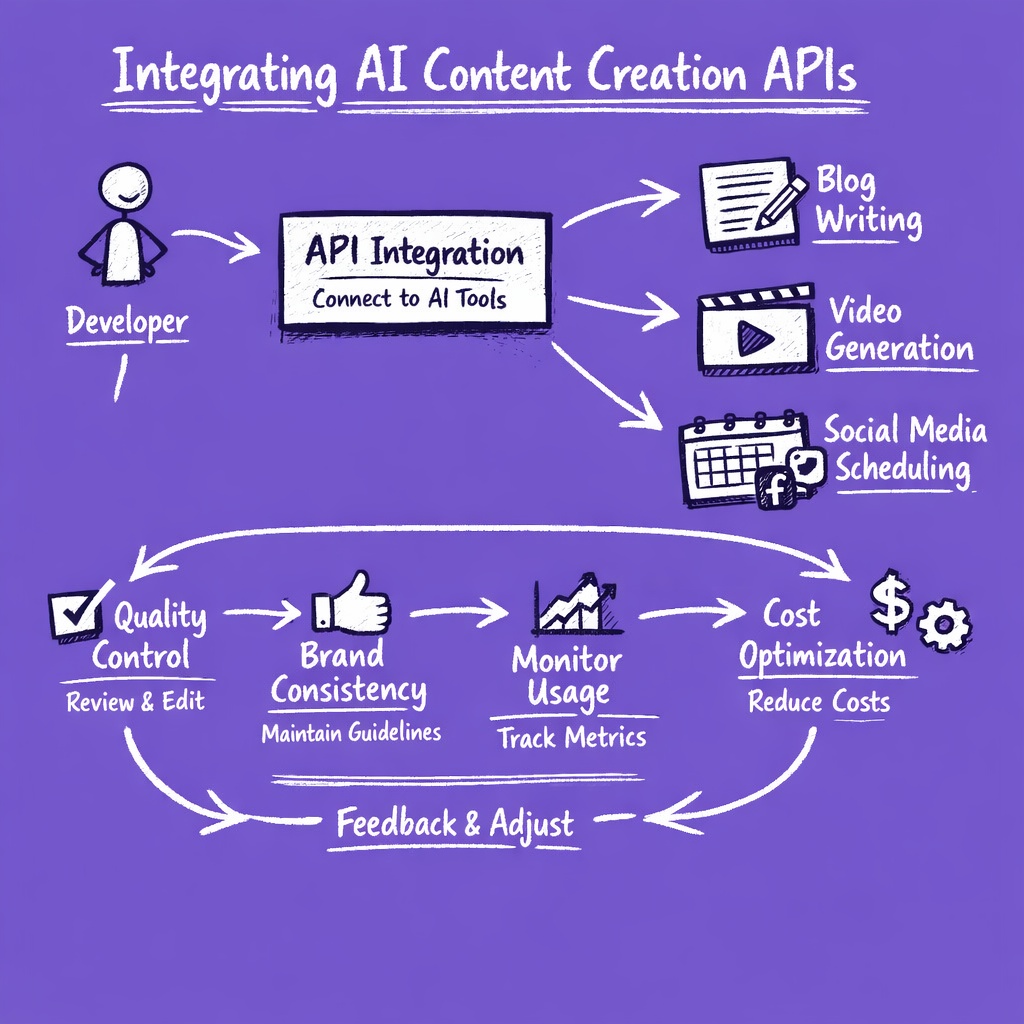 Hand-drawn flowchart diagram showing integration of AI content creation APIs for blogs, videos, and social media into developer workflows with quality control and monitoring.
Whiteboard style flowchart of AI content creation API integration covering blogs, videos, social media, quality assurance, monitoring, and scalability.
Sources
- [1]Postiv AI Bloghttps://postiv.ai/blog/ai-content-creation-tools
- [2]Meet Sonahttps://meetsona.ai/blog/best-ai-content-creation-tools/
- [3]Higgsfield AIhttps://higgsfield.ai/blog/best-ai-video-generators-2026
- [4]Bufferhttps://buffer.com/resources/ai-social-media-content-creation/
- [5]Pingeneratorhttps://pingenerator.com/blog/best-ai-tools-for-social-media
- [6]Eclincherhttps://www.eclincher.com/articles/12-best-social-media-schedulers-in-2026-features-and-pricing
- [7]Zapierhttps://zapier.com/blog/best-ai-social-media-management/
- [8]Sourcehttps://www.brandedagency.com/blog/best-ai-content-tools
- [9]Sourcehttps://www.getblend.com/blog/10-best-ai-tools-to-use-for-content-creation/
- [10]Netlifyhttps://www.netlify.com/guides/best-ai-content-generation-tools/
Ready to start creating?
Join 10,000+ creators in the AI Video Forging community and get instant access to 50+ hours of training.
Join — $9/mo