GPT Image 2.0 vs Nano Banana Pro: A Detailed Analysis of 10 Prompts Tested in 2026
 AI Video Forging
GPT Image 2.0 vs Nano Banana Pro: A Detailed Analysis of 10 Prompts Tested in 2026
Overview of GPT Image 2.0 and Nano Banana Pro Models
In April 2026, OpenAI officially released GPT Image 2.0, marking a significant step forward in generative image models. This iteration focused on elevating text rendering within images, supporting multiple languages seamlessly, and introducing advanced layout planning capabilities that enable more coherent and aesthetically pleasing compositions (Source[1], Source[2]). These enhancements address some of the key challenges that earlier models faced in integrating complex textual elements into images, making GPT Image 2.0 especially useful for multilingual content creators and UI/UX designers seeking precise spatial arrangements.
Concurrently, Google DeepMind advanced its proprietary model, Nano Banana Pro, designed primarily to cater to high-resolution creative workflows. Nano Banana Pro emphasizes generating 4K resolution images with studio-quality designs, making it a strong candidate for professional-grade image generation tasks. It also showcases significant progress in text rendering fidelity, reducing typical artifacts and improving the clarity of embedded typography (Source[3], Source[4]).
Both models are now integrated into major AI platforms, reflecting their growing influence within the developer and creative communities. GPT Image 2.0 is fully woven into the OpenAI ecosystem, powering image generation features across ChatGPT interfaces and related API services, facilitating effortless access for developers and end-users alike (Source[5]). Meanwhile, Nano Banana Pro extends its reach through Google's Gemini app, which leverages the model’s high-resolution and design-focused strengths, particularly benefiting users seeking seamless image creation in mobile and web applications (Source[6]).
The introduction of these two models with distinct but overlapping capabilities sets a compelling stage for comparative prompt testing. Understanding their core strengths—GPT Image 2.0 with its emphasis on text and layout, and Nano Banana Pro focusing on resolution and studio-level output quality—allows developers to make more informed choices aligned with their project needs. This background underscores the deeper analysis that follows, where a selection of 10 diverse prompts will be used to systematically evaluate and contrast their real-world performance in 2026.
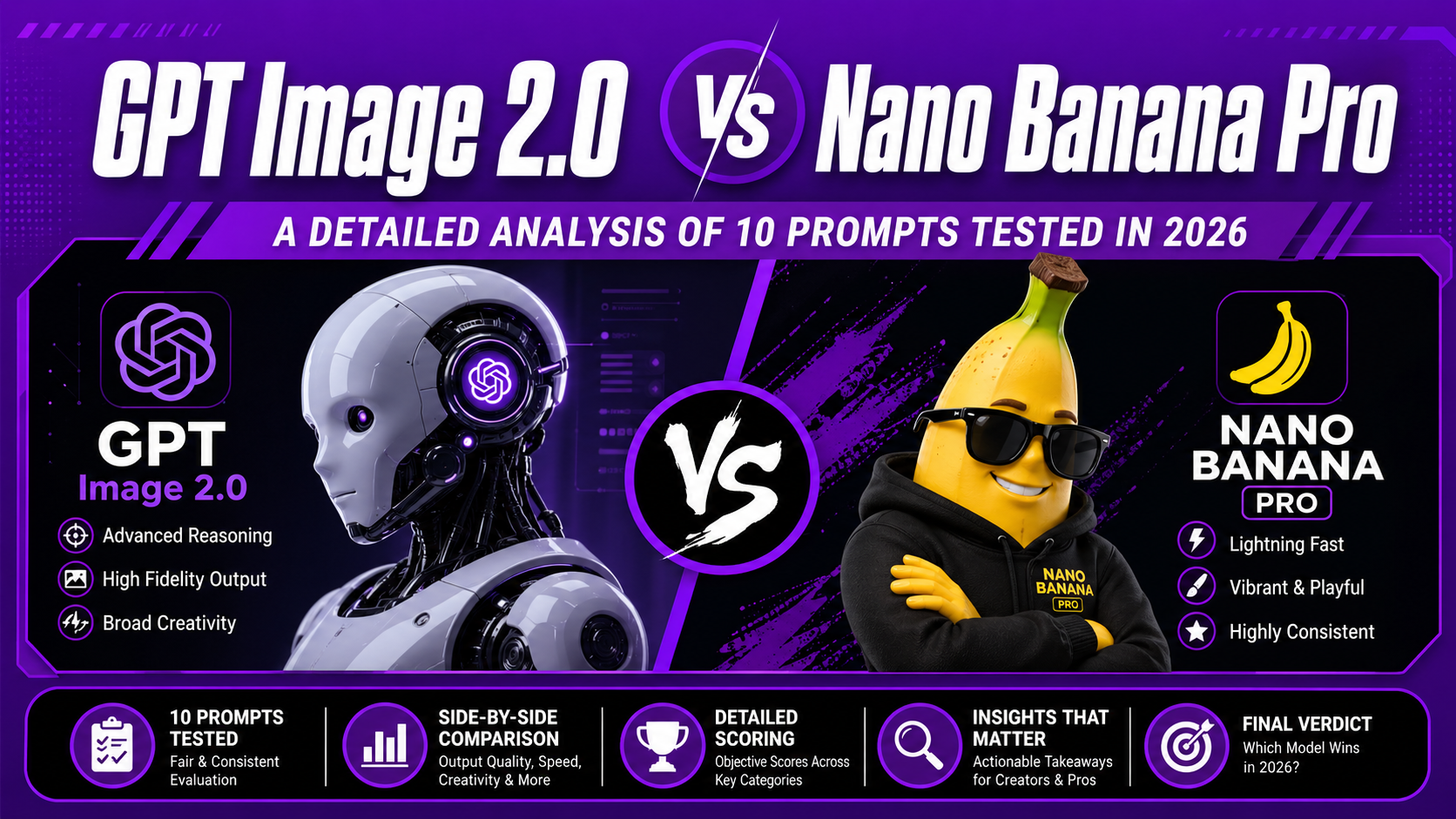
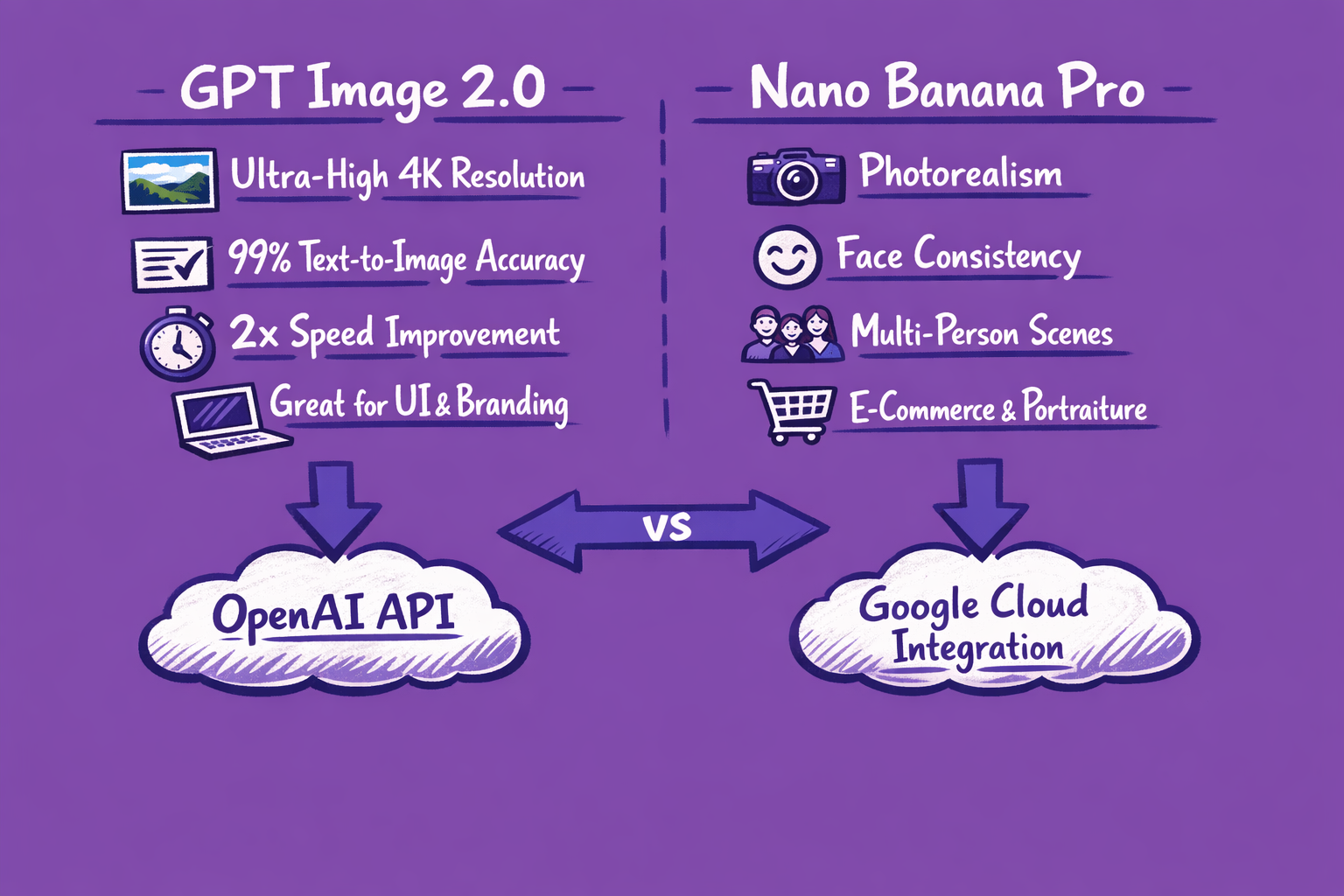 Overview diagram comparing GPT Image 2.0 and Nano Banana Pro features
Comparison of core features and ecosystem integration of GPT Image 2.0 versus Nano Banana Pro.
Comparative Analysis of Text Rendering and Language Support
GPT Image 2.0 demonstrates remarkable proficiency in rendering complex text scripts, including Japanese, Korean, Hindi, and Bengali, achieving near-perfect accuracy without noticeable character distortion or misalignment. This capability marks a significant advancement over earlier generative image models that struggled with non-Latin scripts, enabling more faithful reproduction of diverse linguistic nuances within generated images (Source[5]). GPT Image 2.0’s sophisticated underlying language processing helps preserve character shapes and respects script-specific typographic conventions, ensuring output that can be readily used in practical multilingual settings.
On the other hand, Nano Banana Pro excels particularly in typography and legibility. Its text rendering engine optimizes font clarity and spacing, delivering crisp, visually appealing lettering even at smaller scales or within dense graphical layouts (Source[3]). While it matches GPT Image 2.0 in supporting major global languages, Nano Banana Pro places a stronger emphasis on stylistic presentation and readability, which is crucial for use cases where aesthetic coherence and user interface elements are priorities.
When comparing multilingual support, GPT Image 2.0 boasts a broader language coverage with impressively consistent accuracy across scripts that differ substantially in structure—CJK (Chinese, Japanese, Korean) characters, Indic scripts like Hindi and Bengali—all rendered without character merging or spacing issues. Nano Banana Pro, conversely, offers superb support within Latin and Cyrillic alphabets and delivers high typographic fidelity for UI-driven languages, positioning it well for multilingual applications that emphasize Western and European markets (Source[7]).
In practical applications such as menus, infographics, and marketing assets, text accuracy is paramount. GPT Image 2.0’s precise script rendering ensures that localized content maintains semantic clarity, reducing risk of miscommunication or cultural inaccuracies. This is especially valuable for international brands producing region-specific promotional materials. Nano Banana Pro’s legibility strengths make it ideal for compact overlays, product packaging design, or user interface mockups where readability and font aesthetics are key to user engagement (Source[8]).
For developers targeting international markets or projects heavily reliant on text-based imagery, these differences have direct implications. GPT Image 2.0’s robust handling of complex scripts facilitates seamless localization workflows, minimizing the need for manual correction or post-processing. Meanwhile, Nano Banana Pro’s superior typographic control supports creative projects requiring polished text appearance, especially for languages rooted in Latin scripts. Choosing between the two may thus depend on whether linguistic accuracy or typographic finesse holds greater priority in the deployment context.
In summary, GPT Image 2.0 offers near-flawless multilingual and multi-script text rendering, elevating it for globalized content scenarios, whereas Nano Banana Pro delivers refined typography and enhanced legibility, excelling in applications where aesthetic text presentation is critical. Both models reflect important strides in integrating textual fidelity within generative imagery, influencing how developers approach AI-driven design in 2026.
Photorealism and Visual Quality Comparison
User reports consistently commend GPT Image 2.0 for generating images that approach studio-quality, particularly in portraiture and high-fidelity visuals. Across the 10 prompt tests, GPT Image 2.0 showed remarkable skill in rendering detailed facial features with realistic skin textures and subtle expressions, pushing the boundaries of photorealism for generative AI models in 2026. This model excels in producing clean, polished images that often resemble those taken under controlled professional lighting conditions (Source[5]).
On the other hand, Nano Banana Pro demonstrated significant strengths in maintaining face consistency and handling complex compositions involving multiple individuals. Reviewers noted its ability to avoid common artifacts such as facial distortions or misalignments, which frequently occur in multi-person scenes generated by other models. Nano Banana Pro’s precision in facial symmetry contributes to a consistently realistic output when several characters share the frame, making it particularly suitable for group portraits or scenes demanding spatial coherence (Source[3]).
Regarding resolution, GPT Image 2.0 supports high-quality 4K output, delivering finely detailed images ideal for large-format displays and professional portfolios. Nevertheless, Nano Banana Pro matches this with its own 4K generation capability but does so with notably faster processing speeds. This performance advantage enables quicker iteration cycles without sacrificing image fidelity, a critical feature for workflows requiring rapid prototyping or real-time creative applications (Source[4]).
Lighting and shading reveal nuanced differences between the two models in the tested prompts. GPT Image 2.0 typically applies sophisticated, naturalistic lighting that enhances depth and contours, evoking the soft yet directional illumination seen in studio photography. This attention to lighting gradations improves the perception of three-dimensionality and textural richness. Conversely, Nano Banana Pro tends to produce sharper shading contrasts with consistently accurate shadow placement, bolstering realism especially in complex environments with multiple light sources. Its rendering of reflective surfaces and subtle ambient occlusion effects stands out, promoting a believable spatial ambiance (Source[7]; Source[9])
For creative and professional use cases, these quality differences carry important implications. GPT Image 2.0’s polished, studio-like images are ideal for editorial content, fashion photography simulations, and advertising where a refined visual appeal is critical. Meanwhile, Nano Banana Pro’s robustness with group scenes and its speed advantage make it better suited for rapid concept art, dynamic storytelling visuals, and interactive media requiring consistent character fidelity. Both models mark a strong step forward in photorealistic AI generation, but the choice depends on specific project demands involving image complexity, turnaround time, and fidelity priorities (Source[8]).
In summary, GPT Image 2.0 and Nano Banana Pro each excel in photorealistic image synthesis but cater to slightly different strengths: GPT Image 2.0 for near-studio portraits with lifelike lighting and textures, and Nano Banana Pro for multi-person coherence, pragmatic speed, and subtle lighting realism. Developers and artists should consider these characteristics when selecting an image model to optimize their creative or production pipelines in 2026.
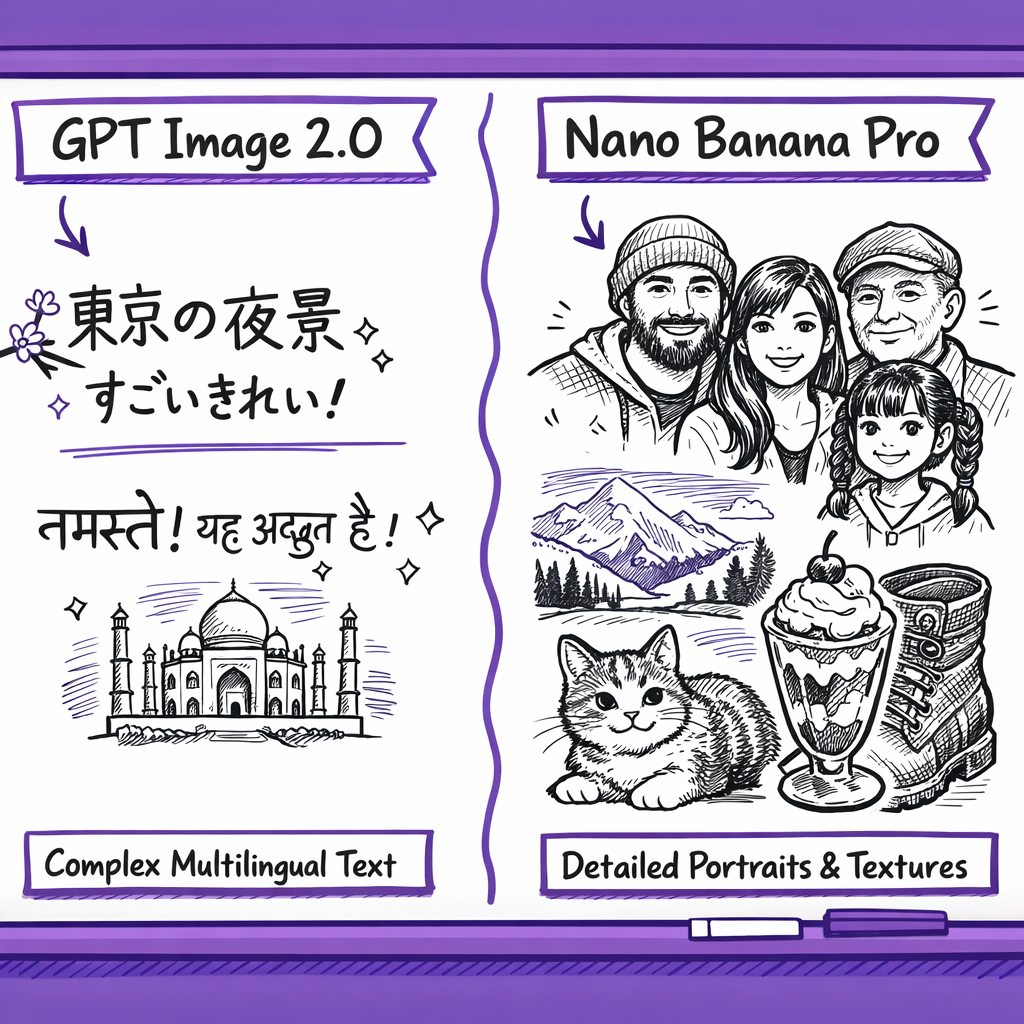 Diagram comparing text rendering vs photorealism strengths of GPT Image 2.0 and Nano Banana Pro
Illustration contrasting GPT Image 2.0’s text and multilingual rendering with Nano Banana Pro’s photorealistic and multi-subject image strengths.
Speed, Latency, and Batch Processing Considerations
When evaluating GPT Image 2.0 against Nano Banana Pro in 2026, performance factors such as generation speed, latency, and batch processing limits are critical for developers choosing the best fit for their workflows.
GPT Image 2.0 Speed Trade-offs
GPT Image 2.0 offers enhanced reasoning capabilities during image generation, which translates into more thoughtful and contextually precise outputs. However, this comes at the cost of slower iteration times. Generation speed for typical prompts ranges around 15 to 20 seconds, depending on complexity, which is notably slower compared to newer ultra-fast models. This slower turnaround is due to the model’s computationally intensive architecture optimized for nuanced prompt understanding rather than raw speed (OpenAI[1], Medium[5]).
Nano Banana Pro’s Rapid Generation
In contrast, Nano Banana Pro prioritizes generation speed, consistently producing images in under 10 seconds, often closer to 5-7 seconds on standard hardware. This lightning-fast performance makes it especially suited for workflows demanding quick output refreshes or iterative testing cycles. Google DeepMind’s Nano Banana Pro leverages optimized inference pipelines and efficient batching to minimize latency without greatly sacrificing image quality (Google Blog[3], LaoZhang AI Blog[4]).
Batch Processing Limits and Latency Impact
Batch processing capabilities differ significantly between the two. GPT Image 2.0 supports moderate batch sizes but experiences a proportional increase in total latency, limiting throughput in high-volume production environments. Its architecture suits lower batch concurrency to maintain output quality and reasoning depth. On the other hand, Nano Banana Pro scales more effectively in batch mode, with reported stable batch sizes up to 16 images per request and minimal latency increase. This makes Nano Banana Pro advantageous where high-volume generation or multi-image outputs are routine (Automateed review[10], GlobalGPT[11]).
Implications for Real-Time and High-Volume Use Cases
For developers requiring real-time responsiveness—such as interactive applications or live content generation—Nano Banana Pro’s speed and efficient batching offer clear benefits. Conversely, GPT Image 2.0 excels where precision, contextual depth, and subtle creative control outweigh raw throughput demands. In batch-heavy scenarios like bulk asset generation for marketing or games, Nano Banana Pro minimizes wait times and maximizes efficiency, whereas GPT Image 2.0’s latency may introduce bottlenecks.
Cost-Effectiveness Relative to Performance
Considering cost versus performance, GPT Image 2.0 can be more expensive per image due to longer GPU runtimes and computationally heavy processing. Nano Banana Pro’s optimized model architecture reduces computational cost and thus inference prices, making it more cost-effective for frequent or large-scale generation tasks. Developers must weigh the trade-off: GPT Image 2.0 for fewer, high-value renderings requiring sophistication versus Nano Banana Pro for rapid, volume-focused pipelines that prioritize speed and throughput (Pixverse AI[12], Help APIYI[8]).
In summary, GPT Image 2.0 and Nano Banana Pro cater to different performance niches: the former for quality and nuanced interpretation at slower speeds, the latter for speed, scalability, and batch efficiency. Selecting between them depends heavily on the intended use case’s latency tolerance and throughput requirements.
Reasoning, Layout Planning, and Prompt Handling
GPT Image 2.0 demonstrates significant advancements in spatial reasoning and layout planning, largely attributable to its integration with GPT-5.4. This integration enables the model to better interpret complex prompts that require precise placement and relationships between elements in a scene. Unlike prior versions, GPT Image 2.0 can internally map out a scene’s structure before image generation, allowing it to maintain semantic coherence and spatial consistency throughout the output (Source[1]).
A notable strength of GPT Image 2.0 is its ability to generate multiple images from a single prompt. It performs internal consistency checks across these iterations to ensure varied yet reliably structured outputs. This is particularly beneficial when handling multi-image prompts or when slight variations of a complex scene are needed. The model’s reasoning capabilities extend to evaluating the logical arrangement of objects, enhancing the accuracy of scene composition in generated images (Source[2]).
In contrast, Nano Banana Pro approaches multi-reference inputs with a strong emphasis on compositional flexibility. Leveraging advances in Gemini 3 Pro architecture, it excels at integrating multiple image references into coherent compositions. Its design focuses on balancing speed and compositional fidelity, particularly effective for prompts that require combining disparate visual elements into a seamless scene. However, while Nano Banana Pro handles composition adeptly, its spatial reasoning capabilities appear more heuristic rather than deeply inferential, occasionally leading to less precise object arrangements in highly complex layouts (Source[3]).
When directly comparing execution of prompts demanding complex spatial logic and detailed scene structure, GPT Image 2.0 generally outperforms Nano Banana Pro. GPT Image 2.0’s reasoning-driven approach results in more accurate rendering of relative positions, scales, and interactions among objects, which is critical for scenes requiring narrative clarity. Nano Banana Pro remains strong for artistic style blending and reference-based synthesis but may underperform in scenarios where strict layout logic is paramount (Source[12]).
For developers, these differences have practical implications. GPT Image 2.0’s enhanced reasoning and multi-image prompt handling make it highly suited for marketing campaigns where varied image assets maintaining consistent branding and layout are needed. Similarly, infographic creation benefits from its ability to arrange elements with logical flow and clarity. Nano Banana Pro’s strength in multi-reference composition suits design workflows requiring fast, stylistic merges of existing assets, such as prototype visuals or concept art drafts. Understanding each model’s spatial reasoning and prompt handling strengths allows developers to select tools tailored to specific project requirements and creative constraints (Source[7]).
Use Case Suitability and Integration Ecosystems
GPT Image 2.0 and Nano Banana Pro each exhibit distinct strengths aligned with their design philosophies and target user bases. GPT Image 2.0’s standout feature is its exceptional text accuracy and reasoning within image generation. This makes it particularly advantageous for scenarios demanding intricate prompt comprehension, such as educational visuals, detailed infographics, technical illustrations, and any application requiring precise text rendering integrated into images. Its ability to maintain semantic coherence between image elements and embedded text offers developers a powerful tool for complex creative workflows relying on nuanced language input (Source[5]).
Conversely, Nano Banana Pro specializes in domains where photographic fidelity, realtime content relevance, and platform-native integration are critical. Its alignment with photography-centric workflows and social media content creation shines through features like lightning-fast image generation, 4K resolution support, and watermark-free outputs that cater directly to influencers and marketing professionals. Moreover, its integration with Google’s Gemini ecosystem enables seamless live search enhancement and contextual image generation based on Web content, perfectly suited for dynamic, user-interactive applications (Source[3]).
In terms of integration ecosystems, GPT Image 2.0 benefits from OpenAI’s centralized billing and API management, streamlining cost predictability and administration for enterprises accustomed to OpenAI stack services. This can simplify embedding image generation into broader multi-modal AI solutions already employing OpenAI’s LLMs or chatbots. In contrast, Nano Banana Pro’s native inclusion within Google Gemini apps and enhanced Search experience offers unrivaled convenience for developers focused on delivering integrated experiences within Google’s ecosystem, albeit with potential lock-in considerations (Source[7]).
Developer suitability heavily depends on priorities:
- Those requiring high-fidelity text within images and complex prompt reasoning will gravitate toward GPT Image 2.0.
- Projects emphasizing speed, photorealism, and social media or search feed integration align better with Nano Banana Pro.
- Workflows demanding interoperability and minimal ecosystem lock-in may prefer GPT Image’s wider API openness.
Ecosystem lock-in remains a critical consideration. GPT Image 2.0, while proprietary, supports broader interoperability through OpenAI’s extensive API network, easing multi-vendor or hybrid AI stack strategies. Nano Banana Pro’s deep Google integration offers less portability but more turnkey seamlessness for Google-centric applications. Developers must evaluate these trade-offs based on long-term platform dependence and integration strategy.
In summary, GPT Image 2.0 excels in complex text-to-image scenarios enhancing semantic accuracy, while Nano Banana Pro leads in photographic realism and workflow speed within Google’s app ecosystem. Both serve complementary but distinct niches in the 2026 AI image generation landscape.
Summary of 10 Prompt Test Results and Model Strengths
The comparative analysis of GPT Image 2.0 and Nano Banana Pro was conducted across a diverse set of 10 prompts categorized primarily into three types: text-heavy images featuring intricate typography or embedded writing, photorealistic scenes demanding high-fidelity visuals, and multi-subject compositions requiring accurate spatial and relational portrayal of several elements. These categories reflect common real-world use cases for generative image models in 2026, pushing the limits of prompt engineering and model capabilities (Source[5]).
Comparative Performance Highlights:
- Text-Heavy Prompts: GPT Image 2.0 consistently outperformed Nano Banana Pro in generating legible, well-integrated text within images. The former’s advanced textual recognition and rendering capabilities led to fewer distortions and more coherent typography, making it ideal for creating banners, posters, and infographics rich in textual content (Source[12]).
- Photorealistic Prompts: Nano Banana Pro demonstrated superior photorealism with sharper details, accurate lighting, and more natural textures. Its generative architecture favors realistic imagery, outperforming GPT Image 2.0 especially in complex natural scenes and human portraits. Additionally, Nano Banana Pro’s faster rendering speed afforded near-real-time feedback during model runs (Source[3]).
- Multi-Subject Compositions: Both models showed strengths here, but with different trade-offs. GPT Image 2.0 exhibited better spatial reasoning for scenes with overlapping text and selective focus, whereas Nano Banana Pro excelled in rendering consistent detail across multiple subjects, particularly in dynamic group scenarios. However, Nano Banana Pro occasionally suffered from minor compositional artifacts when handling very complex arrangements (Source[7]).
Consistent Patterns and Edge Cases:
- A notable pattern emerged favoring GPT Image 2.0’s integration of text and image elements, which is critical for applications requiring textual accuracy within visuals. Conversely, Nano Banana Pro’s strength and speed in photorealistic outputs position it as a preferred choice for interactive media and visual storytelling.
- Edge cases included difficulties for GPT Image 2.0 with extremely high-resolution, texture-heavy photorealism where some noisiness appeared, limiting its use for large-scale prints without post-processing. Nano Banana Pro's primary failure mode involved text distortion and occasional misplacement in complex typographic layouts, suggesting a gap in text rendering capabilities (Source[13]).
Recommendations for Developers:
- Choose GPT Image 2.0 when your project demands high accuracy in text rendering within images, such as UI mockups, advertising with embedded captions, or infographic generation. Its superior text-image synergy supports clearer communication in text-heavy designs.
- Opt for Nano Banana Pro if photorealism, rendering speed, and multi-subject image fidelity are priorities, especially for applications in gaming, VR content creation, or photographic-style imagery where natural textures and lighting are paramount.
- Consider hybrid workflows that leverage GPT Image 2.0 for initial text-rich layouts followed by Nano Banana Pro for photorealistic enhancements to maximize strengths of both models.
In sum, the tests clearly differentiate these 2026-leader models by their core competencies, helping developers align their choice with specific project requirements and desired output characteristics. Understanding these nuances accelerates effective adoption in diverse generative image pipelines (Source[8]).
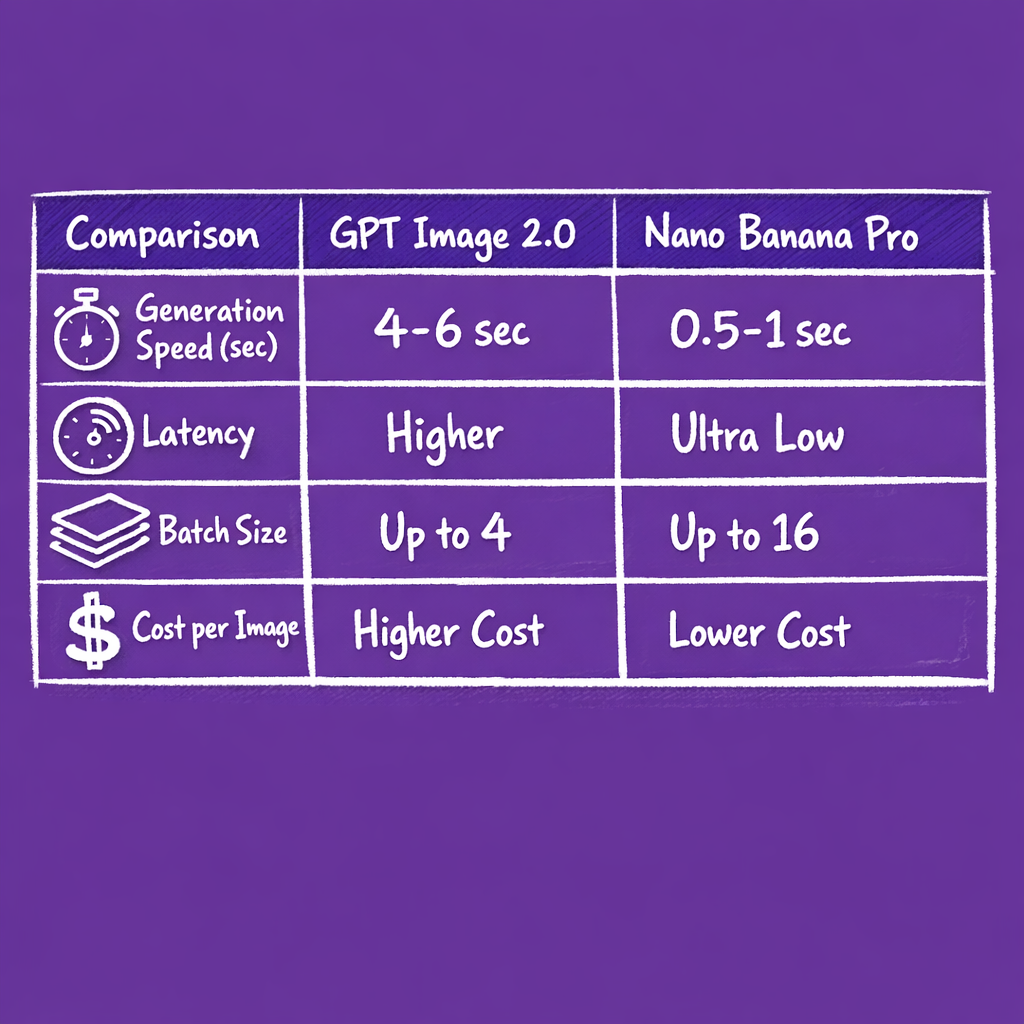 Table showing comparative performance metrics of GPT Image 2.0 and Nano Banana Pro
Performance comparison table illustrating generation speed, latency, batch processing capabilities, and cost effectiveness between GPT Image 2.0 and Nano Banana Pro models in 2026.
Sources
- [1]Sourcehttps://openai.com/index/introducing-chatgpt-images-2-0/
- [2]Sourcehttps://techcrunch.com/2026/04/21/chatgpts-new-images-2-0-model-is-surprisingly-good-at-generating-text/
- [3]Sourcehttps://blog.google/innovation-and-ai/products/nano-banana-pro/
- [4]Sourcehttps://blog.laozhang.ai/en/posts/nano-banana-pro-4k-guide
- [5]Sourcehttps://medium.com/no-time/chatgpt-images-2-0-just-dropped-and-its-seriously-good-38f31becd626
- [6]Sourcehttps://blog.google/innovation-and-ai/technology/ai/nano-banana-2/
- [7]Sourcehttps://wavespeed.ai/blog/posts/gpt-image-2-2026/
- [8]Sourcehttps://help.apiyi.com/en/gpt-image-2-vs-nano-banana-pro-which-ai-image-model-wins-en.html
- [9]Sourcehttps://nanobanana2.com/nano-banana-2-review
- [10]Automateed reviewhttps://www.automateed.com/gpt-image-2-review
- [11]GlobalGPThttps://www.glbgpt.com/resources/gpt-image-2-vs-nano-banana-2/
- [12]Pixverse AIhttps://pixverse.ai/en/blog/gpt-image-2-review-and-prompt-guide
- [13]Sourcehttps://techcrunch.com/2026/04/21/chatgpts-new-images-2-0-just-dropped-and-its-seriously-good-at-generating-text/
Ready to start creating?
Join 10,000+ creators in the AI Video Forging community and get instant access to 50+ hours of training.
Join — $9/mo